Add $12.00 to get Free Gift



Somebody asked this question in a group chat once, and the silence that followed was deafening. Half the room nodded confidently, half shrugged like they'd just been handed a calculus exam in a language they'd never studied. Both reactions, it turns out, are completely valid.
The G-spot debate is one of the most genuinely fascinating puzzles in sexual health. Not because the answer is impossibly complicated. Because the question itself has been asked wrong for decades.
What Even Is the G-Spot? Let's Start at the Beginning

The G-spot gets its name from Ernst Gräfenberg, a German gynecologist who described a sensitive zone on the anterior vaginal wall back in 1950. He wasn't the first to notice it. He was just the first to get his name attached to it, which is very on-brand for medical history.
For years, the broader medical world treated the G-spot like a mythical creature. Something people swore they'd experienced but nobody could quite prove with dissection or imaging.
Here's where the science gets genuinely interesting: researchers eventually realized they were looking for the wrong thing. They were hunting for a discrete anatomical structure, a button, a gland, a clearly defined spot. What they found instead was something called the clitourethrovaginal complex, or CUV complex. This is a convergence zone where the internal clitoris, the urethra, and the anterior vaginal wall overlap and interact. Jannini et al. described this in Nature Reviews Urology as a "variable, multifaceted morphofunctional area" that, when properly stimulated, could produce the responses long attributed to the mythologized G-spot (Jannini et al., 2014).
The G-spot isn't a button. It's a neighborhood.
So Do All Women Actually Have One?

Here's where the science gets refreshingly honest: nobody fully agrees. A 2021 systematic review of 31 studies found that 62.9% of women self-reported having a G-spot, while clinical identification occurred in about 55.4% of participants across studies. In two of those studies, researchers couldn't reliably identify it in anyone at all.
That's not a typo.
What this means for you is simple: the anatomy is genuinely variable between people. The clitoris, which is far larger internally than any of us were ever taught, extends in legs and bulbs deep into the pelvic tissue. Depending on how that internal structure sits in your specific body, the CUV zone might be highly sensitive for you, mildly responsive, or just... unremarkable. None of those outcomes makes your body wrong or broken or less-than.
Think of it like taste buds. Most people can taste bitterness. But the intensity varies wildly between individuals. Your G-spot sensitivity is essentially the same kind of biological variability. Annoying that nobody taught us this, honestly.
Why Some People Find It Easily and Others Never Do
Anatomy is personal in ways medicine is only beginning to take seriously. The angle of your uterus, the precise distribution of nerve endings in your vaginal wall, the position of surrounding structures. These all shift the experience dramatically from one person to the next.
Arousal level also matters enormously here.
The internal clitoris and the tissue surrounding the anterior vaginal wall engorge when you're turned on, just like erectile tissue anywhere else in the body. Exploring for G-spot sensation when you're not yet fully aroused is a bit like trying to find a landmark in a city that hasn't woken up yet. Give yourself time. Give yourself warmth first. External stimulation before internal is not optional prep work. It's the whole first act.
Position matters too. The classic angle for internal G-zone stimulation points toward your navel, roughly 5–8 cm inside along the front wall. A curved toy designed for internal stimulation, like the Gii Glow G-spot vibrator, can make this exploration much easier than fingers alone because it maintains the right angle without your wrist staging a protest.
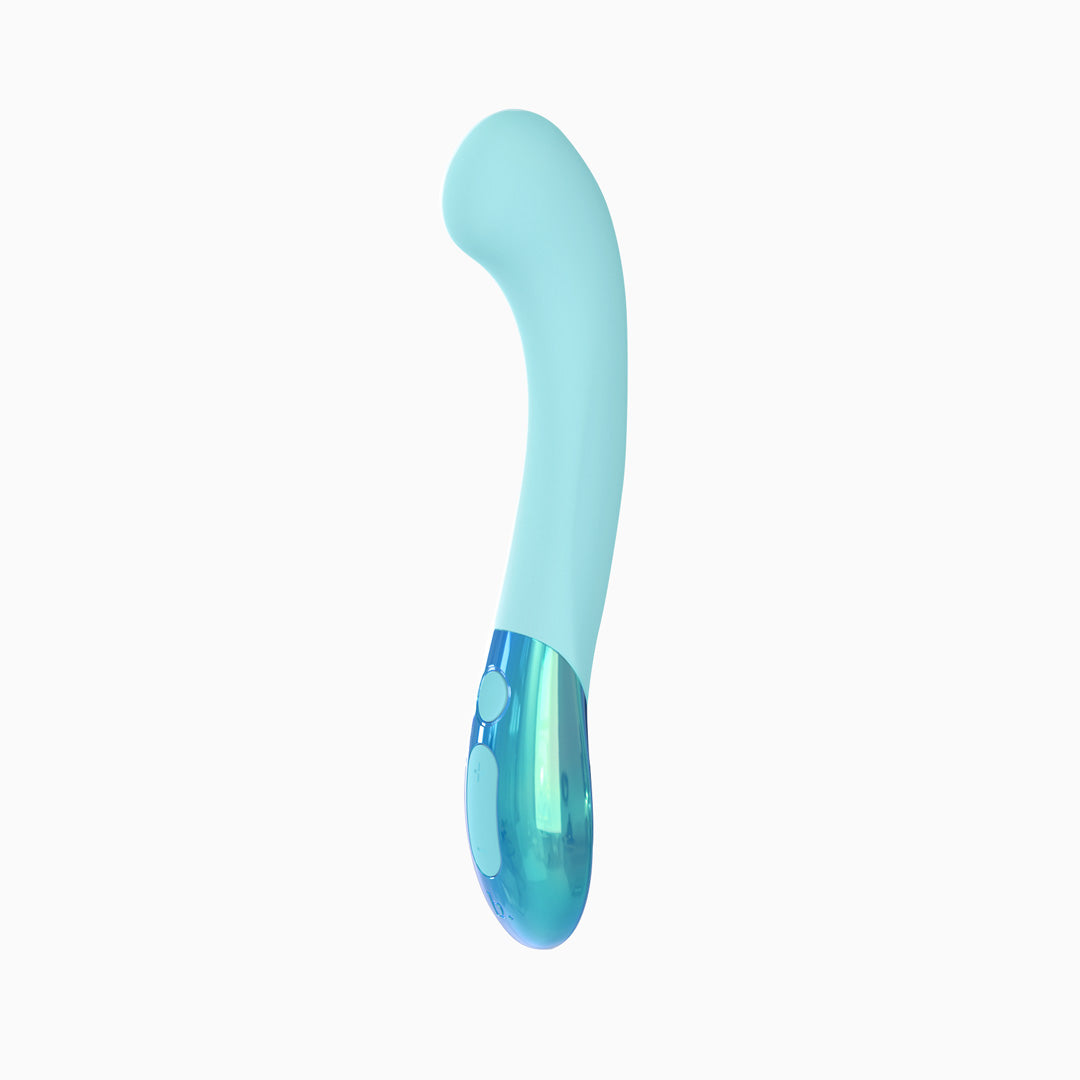
The Gii Glow's gentle curve is genuinely built for this kind of intentional exploration. It's the kind of tool that removes the guesswork, so you can focus on actually noticing sensation instead of fighting physics.
The Clitoris Was Always the Star
Let's be honest about something the medical community took embarrassingly long to admit. The clitoris extends roughly 9–11 cm internally. The small external nub most anatomy diagrams bothered to draw is just the tip. The real structure extends in two crura and two vestibular bulbs deep into the pelvic region, wrapping around the vaginal canal.
Most of what people experience as G-spot pleasure is the internal clitoral structure being stimulated through the vaginal wall.
This reframe changes everything. If you've searched for a G-spot and found nothing dramatic, you might simply be someone whose internal clitoral anatomy doesn't create intense sensation through that particular route. That doesn't mean you're missing anything. It often means external clitoral stimulation is your primary pathway, and that is not a consolation prize. For many people, it's the main event and the only event they ever need. If you want to explore what clitoral vibrators feel like when you're also internally aroused, that combination can be genuinely revelatory for people who assumed their body was just "not G-spot responsive."
What About Squirting? Is That Related?
This question always follows, like clockwork. Squirting, or female ejaculation, is frequently linked to G-spot stimulation in popular culture, and there is overlap. The Skene's glands, sometimes called the female prostate, are located near the urethra in the CUV zone. Stimulation of that area triggers fluid release in some people.
But squirting and G-spot sensitivity are not the same thing.
Not everyone squirts. Not everyone who squirts does so specifically from internal stimulation. And squirting's absence or presence confirms nothing about whether your G-spot zone is functional or sensitive. Bodies do what bodies do, and none of it is a pass/fail situation.
How to Actually Explore This for Yourself
Start with full arousal. This is the non-negotiable part. Spend real time on external stimulation first, because the internal tissue needs blood flow before it becomes receptive. The difference in internal sensation between exploring pre-arousal and mid-arousal is not subtle at all.
Use the right angle, and be patient.
Lie on your back with your knees bent and slightly raised. Insert fingers or a curved toy and angle upward toward your navel. The texture in the CUV zone, if it's responsive for you, often feels slightly different from the surrounding tissue. Some describe it as ridged or spongier. Others notice no textural difference whatsoever. Both experiences are within the range of normal. You can also experiment with masturbation positions that shift the internal angle naturally, because sometimes a small positional change makes a dramatic difference.
For partnered exploration, certain positions create more pressure on the anterior vaginal wall. If you want a guide to those, the breakdown of the most pleasurable sex positions covers that territory with the specificity it deserves.
Debunking the Myths That Keep Circulating
Myth one: if you've never had a G-spot orgasm, you're doing it wrong. No. You might just be a person for whom that pathway isn't the primary route, and that is a completely normal anatomical variation.
Myth two: G-spot orgasms are deeper or more meaningful than clitoral ones. This is subjective, and honestly a little condescending. An orgasm is an orgasm. Your nervous system doesn't rank them by prestige.
Myth three: the right partner will always find it. Partners are wonderful. But nobody knows your body better than you do. Exploration is something you can lead, and that's not a criticism of intimacy. It's an argument for self-knowledge first. If you're newer to that kind of solo exploration, this open letter about self-pleasure might be exactly the permission slip you didn't know you needed.
Here's What Actually Matters
Whether or not you have a highly sensitive G-zone, your capacity for pleasure is real and genuinely worth exploring. The body doesn't follow a single blueprint. Some people experience intense internal sensation, some prefer external stimulation exclusively, and many enjoy both in different contexts depending on mood, arousal, time of the month, and roughly a hundred other variables.
None of those is the correct version.
The most useful question isn't "do I have a G-spot?" It's "what feels good for me, and am I giving myself actual permission to find out?" That second question is the one worth sitting with. If exploring vibrators for women feels like one way to start answering it, that's a perfectly reasonable place to begin. Your pleasure isn't a mystery to be solved by someone else. It's a conversation between you and your own body.
Want to make your journey even more exciting? I've handpicked some amazing toys and goodies at Hello Nancy that'll add extra sparkle to your intimate moments. (Here's a little secret, use 'dirtytalk' for 10% off!)
Frequently Asked Questions
Do all women have a G-spot?
Not all women experience G-spot sensitivity in the same way, and research suggests the anatomy varies significantly between individuals. Rather than a universal structure, the G-spot is better understood as a sensitive zone in the clitourethrovaginal complex, which differs in size and nerve density from person to person. Some people feel intense sensation there, others feel very little.
Where exactly is the G-spot located?
The G-spot is typically described as being located on the anterior (front) wall of the vagina, about 5–8 cm inside, toward the navel. The tissue there may feel slightly ridged or spongy compared to the surrounding area, especially when fully aroused.
Why can't I feel my G-spot?
There are a few common reasons. You might not be fully aroused before exploring, which means the internal tissue hasn't engorged yet and is far less sensitive. Your internal anatomy might also be positioned in a way where stimulation through the vaginal wall produces less sensation, which is a normal variation and not a problem to fix.
Is the G-spot the same as the clitoris?
They're connected but not identical. The internal clitoris extends deep into the pelvic region, and G-spot stimulation is largely thought to activate the internal clitoral structures through the vaginal wall. The two systems overlap significantly in the clitourethrovaginal complex, which is why separating them anatomically is more complicated than older textbooks suggested.
Can you have a G-spot orgasm without squirting?
Absolutely yes. Squirting and G-spot orgasms are related but distinct phenomena. Many people experience intense internal orgasms without any fluid release, and many people who do squirt don't necessarily describe it as an orgasm at all. The two can overlap, but neither one is required for the other.
What is the best sex position to stimulate the G-spot?
Positions where penetration angles upward toward the front wall of the vagina tend to work best. These include being on top (allowing you to control depth and angle), doggy style with hips tilted downward, or missionary with a pillow under the hips to shift the angle. The key is experimenting until the pressure lands on the anterior wall.
Does arousal affect G-spot sensitivity?
Yes, dramatically. The internal clitoral tissue and the tissue around the anterior vaginal wall engorge with blood during arousal, much like erectile tissue. Exploring internal sensation when not fully aroused often produces very little result, which is why adequate warm-up beforehand makes a significant difference in what you actually feel.
Can a curved vibrator help find the G-spot?
Yes. A curved vibrator maintains the upward angle toward the anterior wall naturally, removing the physical awkwardness of trying to achieve that angle with fingers alone. Toys like the Gii Glow are specifically shaped for internal G-zone exploration and can make the process much more intuitive and comfortable.
Is it normal to feel like you need to pee during G-spot stimulation?
Very normal. The G-spot zone sits close to the urethra and bladder, so pressure in that area can trigger a sensation that feels like urgency to urinate. For most people, that sensation either fades as arousal increases or transforms into something that feels pleasurable rather than alarming. Emptying your bladder beforehand can also reduce the intensity of that feeling.