Add $12.00 to get Free Gift



Nobody hands you a manual when you hit puberty. You just figure things out on your own, usually with a mix of confusion, Google searches, and quiet panic.
If you've ever looked at yourself in the mirror and thought "wait, is that normal?" you are absolutely not alone. Erection angles are one of those deeply private topics that almost nobody talks about, even though pretty much everyone with a penis has wondered about theirs at some point.
Here's the truth: there is no single "normal" angle. The range is genuinely enormous.
What Is an Erection Angle, Exactly?

An erection angle is simply the direction your erect penis points relative to your body. Think of your abdomen as a reference point. A penis pointing straight up at your belly button sits at roughly 0 degrees from vertical. One pointing straight outward sits around 90 degrees. One angling downward toward the floor lands past 90 degrees, and so on.
According to clinical sources, the typical range runs from 45 to 90 degrees from the vertical plane, but the full spectrum observed in real people runs anywhere from nearly pointing at your face to angling downward. A study-level overview on ScienceDirect describes the erection angle as following a normal distribution from 0 to 180 degrees, with a clinical mean around 90 degrees relative to the abdominal surface (andrologyexpert.com, 2024).
That is a massive range.
Why Does the Angle Vary So Much?
Several factors shape your angle, and almost none of them are within your control. Ligament length and elasticity play the biggest role. The suspensory ligament attached to the pubic bone is essentially your angle anchor. Shorter or tighter ligaments tend to pull the penis upward toward the abdomen. Longer or more lax ligaments allow it to hang lower or point outward.
Age also matters. Younger people with greater ligament elasticity often have higher angles. As connective tissue gradually loses some flexibility over time, the angle can shift slightly downward. This is a completely natural process, not a sign that anything is wrong.
Body weight, the position of the pubic fat pad, and individual pelvic anatomy all add extra variation into the mix.
The Full Spectrum: Upward, Straight, and Downward Angles
Let's walk through the three broad categories you'll actually encounter.
An upward angle means the erect penis points toward the belly button or even higher. This is extremely common, especially in younger people. It can make certain sexual positions feel more intuitive while others require a bit of creative adjustment. Nothing about this angle suggests any health issue whatsoever.
A straight or near-horizontal angle, pointing more or less outward from the body, is also entirely typical. It sits in the middle of the distribution and works well across a wide variety of positions.
A downward angle, where the erect penis points below the horizontal line, is less common but still well within the range of normal human anatomy. People with a downward angle often find that certain positions that work for an upward angle feel awkward, and vice versa. The solution is simply experimenting with what feels good for both partners, rather than assuming something is broken.
Left, Right, and the Curve Question
Angles don't only go up and down. Many people have a slight left or right lean as well. A mild lateral curve is almost always anatomically normal, caused by asymmetrical development of the internal erectile chambers during puberty. The chambers, known as the corpora cavernosa, sometimes expand at slightly different rates, creating a gentle bend when fully erect.
This is worth separating from Peyronie's disease, which involves fibrous scar tissue causing a more pronounced, painful curvature. If your curve is mild, appeared during puberty, causes no pain, and doesn't interfere with function, it is almost certainly just your anatomy. If a significant curve appeared suddenly in adulthood, especially with discomfort, that is worth a conversation with a doctor.
Does Erection Angle Actually Affect Sex?

Honestly? Less than most people fear, and more than most people realize.
Angle does influence which positions feel most comfortable and which positions create the most pleasurable friction for both partners. A person with a higher upward angle may find missionary-style positions where they are on top feel deeply satisfying, because the natural curve creates direct pressure against the front wall of the vagina or the prostate. A person with a downward angle may find that legs-up positions that target the G-spot work beautifully for them, since the geometry lines up differently.
The key insight is that your angle is a feature, not a flaw. You can work with it once you understand it.
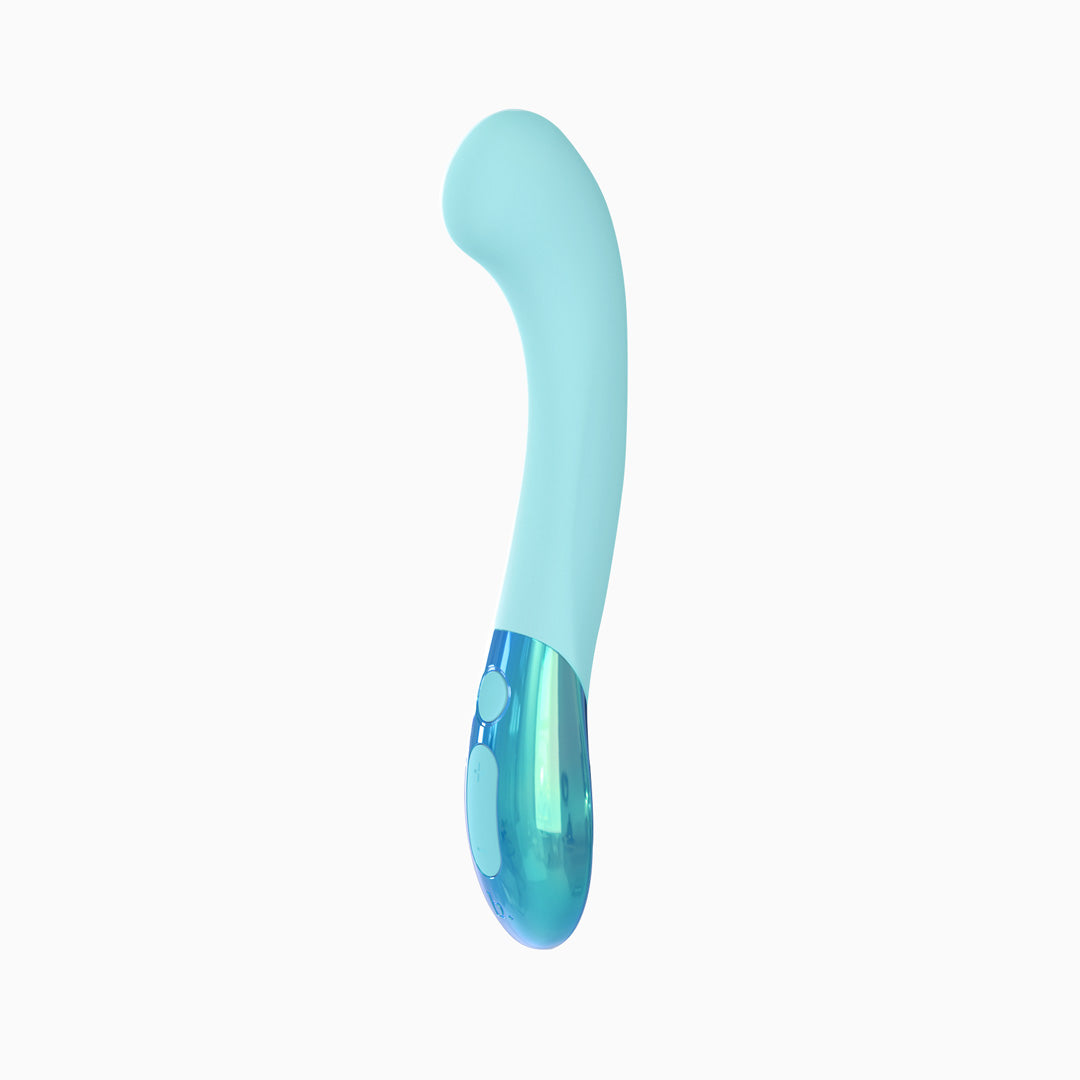
For couples who love adding toys into the mix, couples toys can help bridge any gap in sensation that angle alone can't provide. A G-spot vibrator like the Gii Glow is especially handy here, because you can control the stimulation angle entirely independently of body geometry.
Partners who want consistent clitoral stimulation during penetrative sex will also find that clitoral vibrators solve a lot of the geometry problem entirely, because they work regardless of which direction anyone is pointing.
When Should You Actually See a Doctor?
Most of the time, never. If your angle has been consistent since you started getting erections, it's your normal. Full stop.
There are a handful of situations where medical input makes sense. A new, sudden curvature in adulthood, particularly if accompanied by pain during erection or sex, can indicate Peyronie's disease and is worth evaluating. Erectile dysfunction, meaning difficulty achieving or maintaining an erection, is a separate issue from angle and has its own well-established treatments. And if your angle causes consistent pain, that is always worth a check-in.
But "my angle looks different from what I've seen online" is not a medical emergency. What you see in pornography is not a representative sample of human anatomy. Full stop.
Talking About It With a Partner
Here's where most people really get stuck. Not the angle itself, but the conversation about it.
Bringing up your anatomy with a partner can feel vulnerable. However, the information is actually practical and helpful. Knowing someone's angle helps you both navigate positions more efficiently, reducing the awkward pause of "wait, this isn't quite working" and replacing it with a more intentional approach. Framing it casually works best. Something like "I've found that this angle tends to work better for me" lands very differently than "I need to warn you about something."
Your pleasure matters. Your anatomy is yours, and communicating about it is an act of confidence, not an apology.
The Comfort of Knowing You're in Good Company
Let's be honest about why this topic stresses people out. We compare ourselves to an extremely small and heavily curated sample of bodies. Mainstream media, pornography, and locker room mythology create a fictional standard that very few actual humans meet.
Real bodies are asymmetrical. Real erections point in all kinds of directions. The variation is the norm, not the exception.
If you've been carrying anxiety about your angle, I genuinely hope reading this helps set it down. You are not unusual. You are not broken. You are just human, and human bodies are beautifully, wildly varied. If exploring your own body's responses is something you want to do with more intention, plenty of vibrators for women and intimate tools exist to support that kind of self-knowledge from every angle.
Bottom Line
Erection angles span an enormous natural range, and almost every angle you could have is medically and functionally normal. What matters is understanding your own anatomy well enough to work with it, and giving yourself permission to stop measuring it against an imaginary standard.
Want to make your journey even more exciting? I've handpicked some amazing toys and goodies at Hello Nancy that'll add extra sparkle to your intimate moments. (Here's a little secret, use 'dirtytalk' for 10% off!)
Frequently Asked Questions
What is the normal erection angle range?
The normal erection angle spans from roughly 0 to 180 degrees relative to the body, with most people falling between 45 and 90 degrees from the vertical plane. Clinical sources note a mean around 90 degrees from the abdominal surface, though the full observed range is enormous. Essentially, there is no single "correct" angle.
Is a downward erection angle normal?
Yes, a downward erection angle is within the normal range of human anatomy. It is less common than an upward or horizontal angle, but it is not a sign of any dysfunction or health problem. Many people with a downward angle simply find that different positions work better for them than the ones most commonly depicted in media.
Does erection angle change with age?
Yes, the angle can shift slightly downward as people age. This happens because ligaments and connective tissue naturally lose some elasticity over time. It is a gradual, normal process and does not indicate erectile dysfunction or any medical issue.
What causes a curved or sideways erection?
A mild lateral curve or slight left/right lean is usually caused by asymmetrical development of the corpora cavernosa during puberty. This is completely normal anatomy. A more significant curve that appeared suddenly in adulthood, especially with pain, could indicate Peyronie's disease and is worth discussing with a healthcare provider.
Does erection angle affect sexual pleasure for a partner?
It can, in the sense that different angles create different points of internal pressure and stimulation. An upward angle, for example, often creates direct pressure on the front vaginal wall. The practical takeaway is that your angle shapes which positions feel most natural, not whether sex is pleasurable. Experimenting with positions and adding toys can help both partners maximize enjoyment regardless of angle.
Can you change your erection angle?
Not significantly, and there is generally no reason to try. The angle is determined by ligament structure and anatomy, which are not meaningfully altered by exercises or devices. Surgery exists to adjust angle in medical cases like severe Peyronie's disease, but it is not something pursued for typical anatomical variation.
What is the difference between erection angle and Peyronie's disease?
Erection angle refers to the natural direction your erect penis points and is present from puberty onward. Peyronie's disease involves fibrous scar tissue forming inside the penis, causing a new and often painful curvature that develops in adulthood. The key distinguishing factors are the onset (sudden vs. lifelong), the degree of curvature, and the presence of pain or discomfort.
Is it normal to have an erection that points straight up against the abdomen?
Absolutely. An erection that lies close to or against the abdomen is common, particularly in younger people with tighter suspensory ligaments. It is one of the most frequently reported angles and is entirely within the normal anatomical range.